
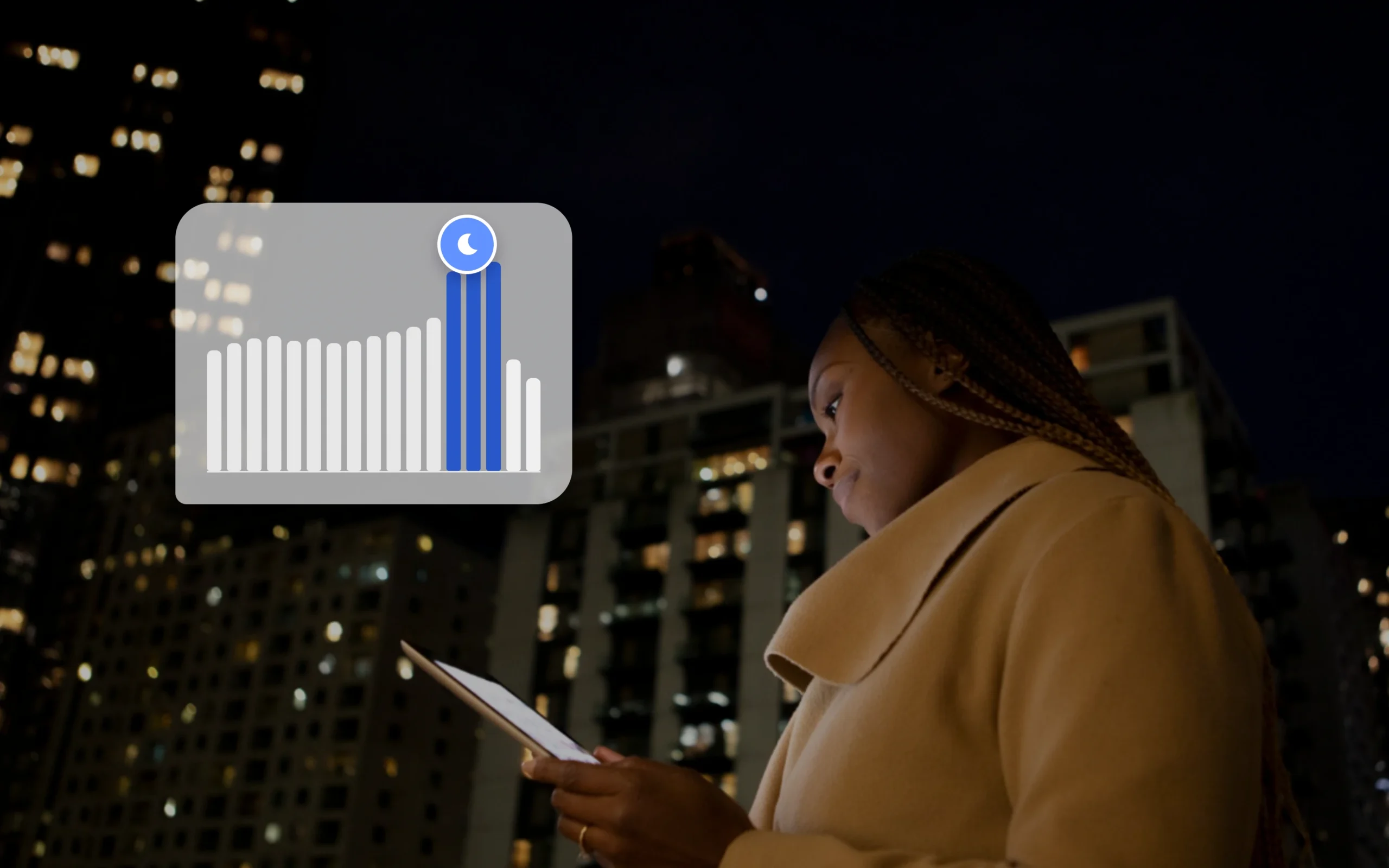
The best time to sell on WhatsApp does not match office hours. August data from a telecommunications operation shows that conversion stays above average until 11 p.m. and only drops after midnight.
What Hourly Conversion on WhatsApp Is and How It Defines the Best Time to Sell
Hourly conversion on WhatsApp is the percentage of handled leads that end in a sale during each time slot of the day. It helps identify the best time to sell on WhatsApp: which hours demand performs best and in which hours an away message is not enough.
The calculation is simple: divide the sales in a time slot by the leads handled in that same slot and multiply by 100.
Hourly conversion = (sales in the time slot ÷ leads handled in the time slot) × 100
Using the August data from the telecommunications operation analyzed below, the result at 12 p.m. is (549 ÷ 3,180) × 100 = 17.3%, and at 10 p.m. it is (419 ÷ 1,859) × 100 = 22.5%.
Note: percentages are rounded to one decimal place (unrounded, they are 17.264% and 22.539%). Sales and leads correspond to the cumulative total for all of August in each hour, not to a single day.
These figures should be read together with volume, because they answer different questions, such as: when do the most people write in, and when do the people who buy write in. At 12 p.m. there was more activity (3,180 leads, the hourly maximum together with 2 p.m.) and more sales were closed (549 versus 419), but at 10 p.m. a larger share of handled leads ended up buying.
That is why the best time to sell on WhatsApp is not the hour with the most messages, but the combination of volume, conversion, and cost of coverage. A high conversion rate in a time slot with few leads is not conclusive either: it is worth looking at both figures before deciding.
Nighttime WhatsApp Support for Sales: Impact on Conversion and Automation
A brand can invest in paid ads and influencers and still lose the sale because of a question nobody answers at 10 p.m. The cost per lead still looks low, but the cost per sale rises because of everyone who drops off at that stage. With a form or an email, the reply arrives the next day, too late for a customer with purchase intent.
Expectations are already moving in that direction. According to Zendesk’s CX Trends 2026 report (11,000 respondents in 22 countries), 74% of consumers now expect 24/7 support because of AI, and 86% say that responsiveness and accurate resolution strongly influence their purchase decision. But note that it is a global customer experience survey, not a study about WhatsApp.
Covering nights and weekends with human teams requires additional shifts and supervision. 24/7 WhatsApp support with AI allows the first response, frequently asked questions, and initial qualification to happen when the customer writes in, and lets the sales team pick up whatever requires human judgment.
AI First in the Conversational Experience: Selling on WhatsApp Outside Business Hours
Being AI First means that the first response, the initial qualification, and routine inquiries are handled by an AI agent, and that people step in for exceptions, complex negotiations, and sensitive cases.
Chat Center, a Meta Business Partner, operates with End to End sales agents that accompany the conversation from the first message to the purchase: they offer products or services, build carts, generate the payment link, and issue quotes, 24 hours a day. The integration with eCommerce makes it possible to close the sale within the same conversation.
The usual objection is loss of control. It is addressed by defining in advance what the agent can answer, which promotions it can offer, and when it must hand off to a person. Chat Center’s results-based model focuses on completed sales, not on message volume.
Real Metrics: Nighttime Conversion and Weekend WhatsApp Support
Now let’s return to the starting point of this blog with data we obtained from a telecommunications operation in August: 46,310 leads handled on WhatsApp, 8,687 sales, and an 18.8% conversion rate. By time slot:
| Time slot | Leads contacted | Sales | Conversion rate |
|---|---|---|---|
| 12 AM – 5 AM | 2,492 | 284 | 11.4% |
| 6 AM – 8 AM | 3,425 | 500 | 14.6% |
| 9 AM – 5 PM | 26,525 | 5,006 | 18.9% |
| 6 PM – 8 PM | 8,272 | 1,714 | 20.7% |
| 9 PM – 11 PM | 5,596 | 1,183 | 21.1% |
The 9 p.m. to 11 p.m. slot converts at 21.1%, above the monthly average, and accounts for 13.6% of sales. The best hour of the month was 10 p.m., at 22.5%. After midnight, conversion drops to 15.8% until 2 a.m., and between 3 a.m. and 5 a.m. the 716 leads handled produced 4 sales. Between 9 p.m. and 5 a.m., 16.9% of sales are concentrated.
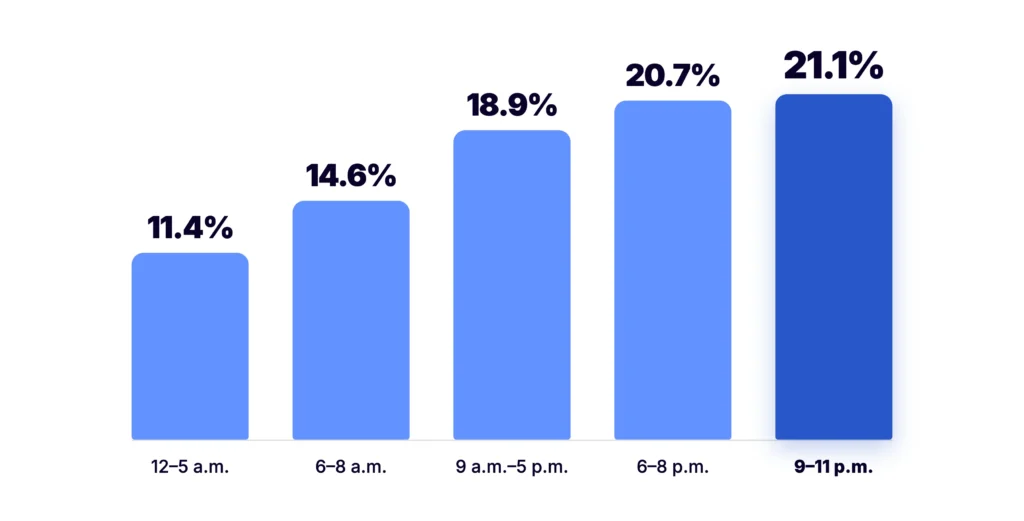
The useful takeaway is not that more sales happen at night, but that nighttime demand can be measured and that its quality depends on the time slot. The data does not measure how much would have been lost without support, nor does it explain the drop in the early morning hours.
In a second Chat Center operation, 22.6% of the conversations opened in August took place on a Saturday or Sunday: each weekend day contributed, on average, 73% of the volume of a business day. In addition, 27.7% were opened between 9 p.m. and 8 a.m. Weekend WhatsApp support is not a marginal case.
At scale, Chat Center records an average conversion rate of 18% in end-to-end sales and 25% in abandonment recovery, and has already managed more than 10 million chats.
How to Start Being AI First Without Redesigning Your Entire Operation
The first step is to measure, not to hire or automate. To do that, you will need to export conversations and sales by hour and day of the week, for at least one full month, and calculate conversion by time slot as in the table above. That way you can answer, with your own data, what the best time to sell on WhatsApp is in your operation, and compare the value of each slot with the cost of covering it.
The second step is to narrow the scope. In this case, we suggest choosing a time slot with proven demand, for example 9 p.m. to 11 p.m. or Saturday, and defining what the AI agent resolves and what it hands off to a person. If a slot has a lot of volume but almost no sales, like 3 a.m. to 5 a.m. in the data analyzed (716 leads and 4 sales), it is worth understanding why before investing in covering it. The third step is to connect the agent to your eCommerce platform or CRM so it can quote and charge without leaving the conversation.
There is an exercise you can do today: count how many conversations you received yesterday between 9 p.m. and 8 a.m., how many were answered in the moment, and how many ended in a sale. If the response only arrived the next day, that is the demand that went cold while ad spend kept running.
At Chat Center, a Meta Business Partner with a results-based model, we help turn the conversational channel into a sales engine with automation and AI, from the first inquiry to the purchase. Book a call and let’s review together how much the demand that reaches you today outside business hours is worth.