
AINS is the category replacing traditional outsourcing with services run end-to-end by artificial intelligence, with payment tied to the result achieved. Here’s what defines it, how it differs from BPO, and what it means for your sales and support operation.
What Is an AI Native Services (AINS)?
An AI Native Services (AINS) is a service model in which artificial intelligence executes a complete business process, without depending on a headcount-based structure as its core, and the client pays for the result obtained (a closed sale, a resolved inquiry, a recovered cart), not for hours worked, software licenses, or number of agents.
This definition marks the fundamental difference from traditional BPO. A BPO provider sells capacity: agents, shifts, licenses for a management software. An AINS provider sells a result executed by an AI system, and that system is what runs the operation, not a workforce that has to be recruited, trained, and supervised.
The Real Difference from Traditional BPO
BPO emerged to outsource repetitive tasks using cheaper or specialized labor, billing by the hour, by FTE (full-time employee assigned), or by license of the software that team uses. Cost grows linearly with volume: more chats, more calls, more inquiries require more agents and more licenses.
The AINS model inverts that logic. AI executes the complete process, from first contact to close, and pricing is tied to the unit of value the company actually seeks: a sale, a resolved conversation, a qualified lead.
McKinsey (2025) documented this shift in the software market: while traditional software vendors mostly use fixed fees, AI-native companies are leaning toward consumption-based pricing by activity and, to a lesser extent, by outcome achieved. That pricing migration is, in essence, the migration from BPO to AINS applied to sales and support services.
For an e-commerce, retail, or CX operation, this changes the conversation with the provider. You no longer negotiate agent headcount or number of licenses. You negotiate a conversion rate, a cart recovery percentage, or a first-response time, and the provider bills based on that number.
Impact on Sales and Automation
The most direct impact of an AINS model is on the relationship between cost and volume. In a BPO, handling more inquiries means adding agents. In an AINS, AI scales without that operational ceiling, and cost stays aligned with results, not effort.
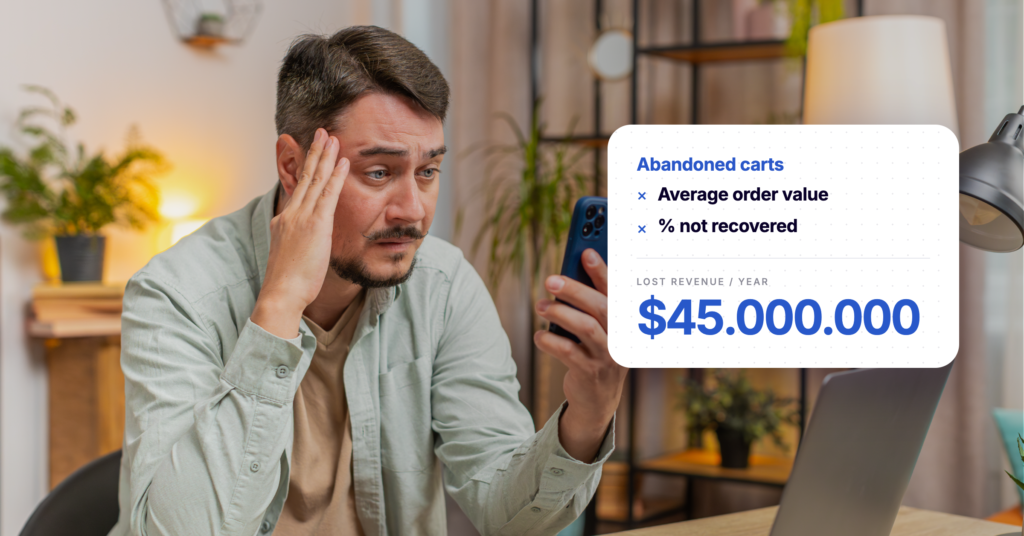
Chat Center operates under this logic in end-to-end WhatsApp automation: the AI agent manages the conversation from the initial greeting through to the closed sale, with an average conversion rate of 18% in complete conversational sales processes. The results-based commercial model also applies to abandoned cart recovery, where WhatsApp automation reaches a 25% conversion rate, far above what a standard recovery email achieves.
This doesn’t replace all human involvement. It replaces the fixed-cost structure with a variable one, tied to what the operation actually sells or resolves.
AI-First in Conversational Experience
Being an AI-First operation doesn’t mean eliminating the human team. It means the AI agent is the default entry point for standard volume, and escalation to a person happens only when the case requires it: a complex objection, a contractual exception, a sensitive complaint.
This addresses head-on the most common objection from CX teams: “I lose control if I automate.” In a well-designed AINS model, control isn’t lost, it’s redefined. The human team stops managing repetitive volume and shifts to overseeing quality, resolving exceptions, and adjusting the business criteria the AI executes. Chat Center, as a Meta Business Partner, integrates this operation directly into the WhatsApp Business ecosystem, connecting the AI agent to the client’s e-commerce platform to build carts, generate quotes, and close sales within the same conversation.
Real Cases and Market Metrics
Market trends back up this category shift. Gartner projects that by 2029, agentic AI will autonomously resolve 80% of common customer service requests without human intervention, driving a 30% reduction in operating costs. That’s exactly the terrain where an AINS operates: less fixed structure, more result per unit of cost.
In practice, this is already showing up in real operations. Assist Card, present in 14 countries, reached a 27% conversion rate and a first-response time of 0.7 minutes, driving a 53% year-over-year revenue increase. Movistar México grew revenue 120% year over year after optimizing prepaid and postpaid portability sales through WhatsApp. Santander, in its Autocompara insurance line, doubled its sales capacity by managing quotes at scale with AI support. In all three cases, the common denominator isn’t the technology itself, but the business result that technology delivered.
How to Start Becoming an AI-First Operation
The first step isn’t choosing a platform, it’s identifying which process in your funnel currently depends on human headcount for repetitive tasks: lead qualification, cart recovery, standard quoting. That’s the process with the highest potential to migrate to an AINS model.
The second step is redefining what metric you’re going to pay for. If today you pay by agent hour or software license, the right question is what business result justifies that spend, and whether that result can be measured and passed directly to the provider as the pricing unit.
The third step is starting with a high-volume, low-risk channel, like WhatsApp, where AI can operate end-to-end with clear escalation rules. You don’t need to migrate the entire operation at once. You need to pick the right process and measure results from month one.
The objection that “this doesn’t scale” loses its force when variable cost is tied to results: if the operation grows, the provider bills more because it generated more sales or more recoveries, not because it added more agents.
If your operation still depends on fixed headcount for processes that could be resolved with end-to-end AI, it’s time to evaluate a results-based model. Book a call with ChatCenter and review which process in your funnel can start getting paid by result, not by hour.