


The second half of the year concentrates most of the strong commercial dates: Buen Fin, Hot Sale, Cyber Monday, Black Friday, Mother’s Day, and Christmas, depending on the market. Preparing your WhatsApp channel for these peaks should be mandatory, with a plan that defines timing, capacity, and automation rules in advance — not on the fly.
Before Each Peak: What Needs to Be Resolved
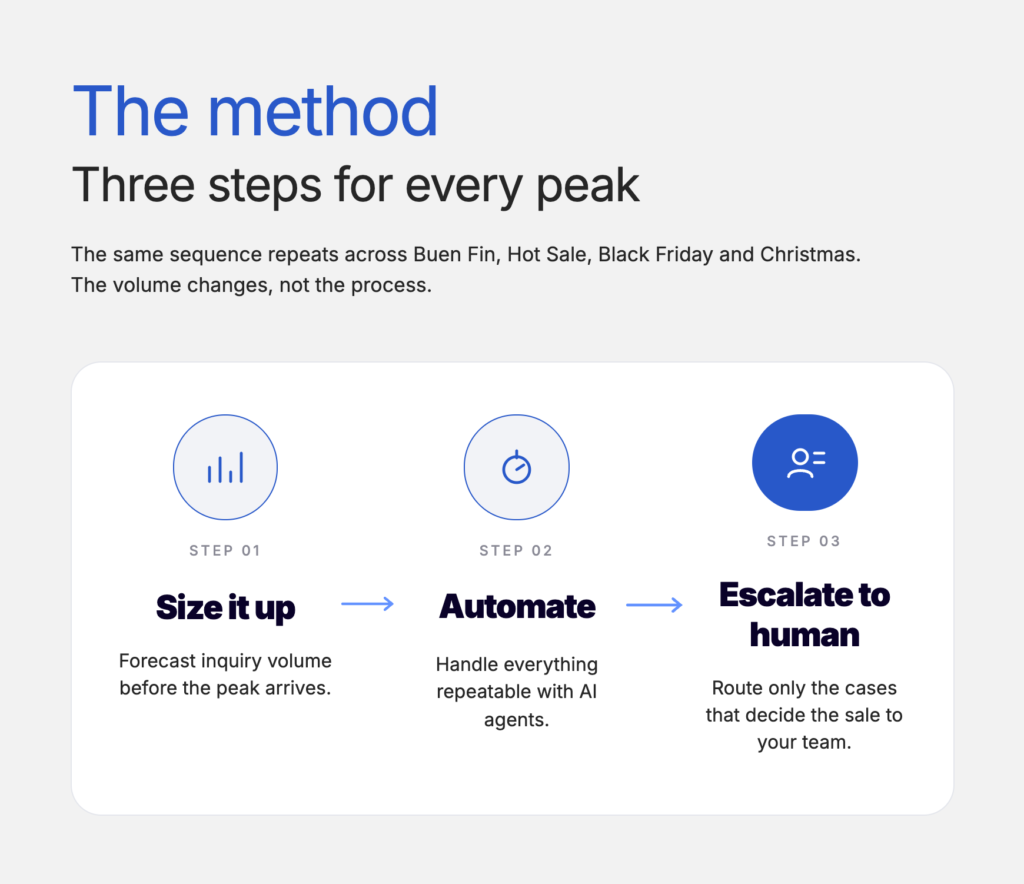
Before the outcome, let’s plan the process. Preparing the WhatsApp channel for a high-traffic date means having three things defined ahead of time:
- How much conversation volume is expected compared to a normal day,
- Which queries automation can resolve without human intervention, and
- At exactly what point a case should escalate to a person.
Without these three answers in writing, every peak gets faced improvising in real time.
Step 1: Map the Semester’s Calendar and Size Each Date
The starting point is the commercial calendar — not a generic one, but one specific to each market. In Spanish-speaking markets, the anchor dates are Buen Fin in Mexico, Hot Sale in Argentina and other countries in the region, Cyber Monday, Black Friday, Mother’s Day (with its own date in each country), and the Christmas season. Each has a different demand profile: Hot Sale and Black Friday concentrate traffic peaks over just a few days, while Christmas extends over a longer period with multiple purchase-decision moments.
Sizing each date means estimating expected volume based on last year’s traffic or the most comparable previous campaign. This number is what defines how much automation is needed: without that prior estimate, there’s no way to know whether the channel will hold up under the peak or saturate mid-campaign.
According to Infobip data on the latest Black Friday and Cyber Monday season, WhatsApp usage in Europe nearly triples during Black Friday, while WhatsApp interaction grows 44% during Cyber Monday. A team sized for the channel’s normal traffic has no margin to absorb that jump without an automation layer to sustain the volume.
Step 2: Automate What’s Repeatable Before the Peak Hits
With volume estimated, the next step is defining what the AI automates and what stays with the human team. On a discount date, most queries repeat: stock availability, promotion terms, shipping times, order status. Automating these responses ahead of the date frees up the team for the cases that actually require judgment: price objections, complaints, or specific product questions.
This is exactly the logic ChatCenter operates on: end-to-end automation over WhatsApp, with a results-based model and Meta Business Partner status to operate the channel within the platform’s official rules. Across the installed customer base, the average conversion rate for managed conversational channels is 18%, and automated cart recovery — critical on high-traffic dates when abandonment also spikes — reaches an average of 25%.
Step 3: Define the Escalation Rules to a Human Agent
The playbook isn’t complete if everything is automated equally. You need to set, in advance, the exact point at which a case moves from AI to a person: when the customer raises a price objection automation can’t resolve, when there’s a complaint about a previous order, or when the query falls outside the expected script. Defining this rule before the peak prevents the team from having to decide case by case, without unified criteria, in the middle of the campaign.
Real-time monitoring during the peak is the last piece: if volume exceeds what was projected in Step 1, the playbook needs to anticipate how to adjust capacity without waiting until the campaign ends to review what went wrong.
Real Case: Maria Cher During the Hot Sale Campaign
Maria Cher, a women’s clothing brand in Argentina, applied this same logic during a real peak date. With an autonomous store operating end to end on Magento and an AI agent absorbing most of the channel’s query volume, the brand managed $329.7 million Argentine pesos in WhatsApp sales over one semester, with 1,479 completed sales.
Within that period, the campaign tied to Hot Sale showed a 16.5% conversion rate across total channel conversations — a number that confirms it’s the prior preparation, not the date itself, that determines whether a sales peak translates into actual sales or a saturated channel. The same pattern repeats across other verticals in ChatCenter’s customer base, such as Movistar México and Santander, where the hybrid AI-and-human-service model sustains conversion even as conversation volume grows sharply.
Before Black Friday or Christmas, Test the Plan on a Smaller Date
The playbook shouldn’t be tested for the first time on the semester’s biggest date. Mother’s Day, with lower volume than Black Friday or Christmas, is the ideal moment to test automation and escalation rules before the bigger peak arrives. What works there gets adjusted and carried, already tested, into the next campaign.
Prepare your WhatsApp channel for the semester’s sales peaks with end-to-end automation. Book a call with ChatCenter and build your operation’s playbook before the next big date hits.
Prepara tu canal de WhatsApp para los picos de venta del semestre con automatización End to End. Agenda una llamada con ChatCenter y arma el playbook de tu operación antes de la próxima fecha fuerte.