
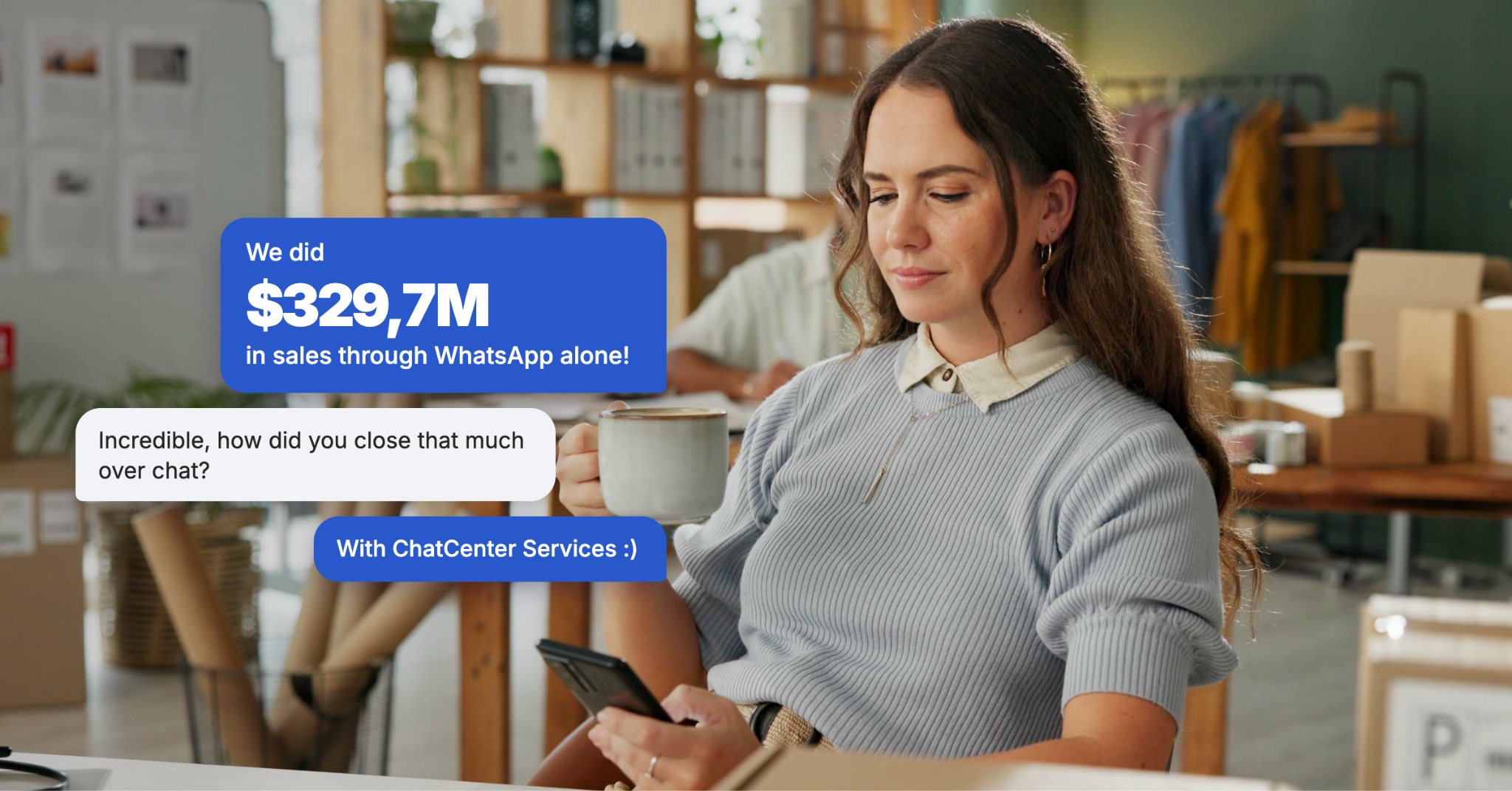
Maria Cher, a women’s apparel brand in Argentina, is a WhatsApp retail success story that shows how conversational automation translates into measurable revenue, not a promise of future efficiency. In a single semester, the channel managed $329.7 million Argentine pesos in sales and completed 1,479 transactions.
How did they do it?
The brand implemented a standalone store built on Magento, an AI agent for customer service, and an abandoned cart module with automated recovery campaigns, all integrated into the WhatsApp channel.
The goal was to optimize the support team’s time and increase the conversational channel’s revenue share. In a single semester, the result was $329.7M ARS managed, 1,479 completed sales, and a 19.7% conversion rate in the best-performing campaign.
The challenge: freeing up the support team without losing revenue
Before implementation, Maria Cher’s challenge had two sides. On one hand, the customer service team was manually absorbing a volume of inquiries that left little room for the cases that actually required human judgment. On the other, the conversational channel had sales potential that wasn’t being captured systematically: inquiries that didn’t convert, carts abandoned with no recovery process behind them.
The goal wasn’t simply to “have a bot” on WhatsApp. It was to optimize the team’s time through AI while simultaneously activating the conversational channel as a conversion engine, with automated campaigns that increased revenue share without relying on an agent handling each case one by one.
The solution: end-to-end automation of the sales channel
The solution combined four pieces:
The first was a standalone store that runs the sale end to end on Magento, without the customer having to leave the conversation to complete the purchase.
The second was an AI agent that absorbs the bulk of service inquiries, freeing the human team for the more complex cases.
The third was an abandoned cart module with native integration, which triggers automated recovery campaigns whenever a sale is left halfway through.
The fourth was a process of continuous channel optimization based on data and feedback, adjusting campaigns to increase revenue share over time.
This approach — end-to-end automation over WhatsApp, with direct integration between eCommerce and AI — is the model ChatCenter operates under generally, as a Meta Business Partner working on a results-based scheme rather than software licensing.
Across ChatCenter’s installed customer base, the average conversion rate for managed conversational channels is 18%, with more than 10 million chats managed in total. In Maria Cher’s specific case, conversion across the channel’s total conversations was 9.8%, with peaks of up to 19.7% in the best-performing campaign.
The results
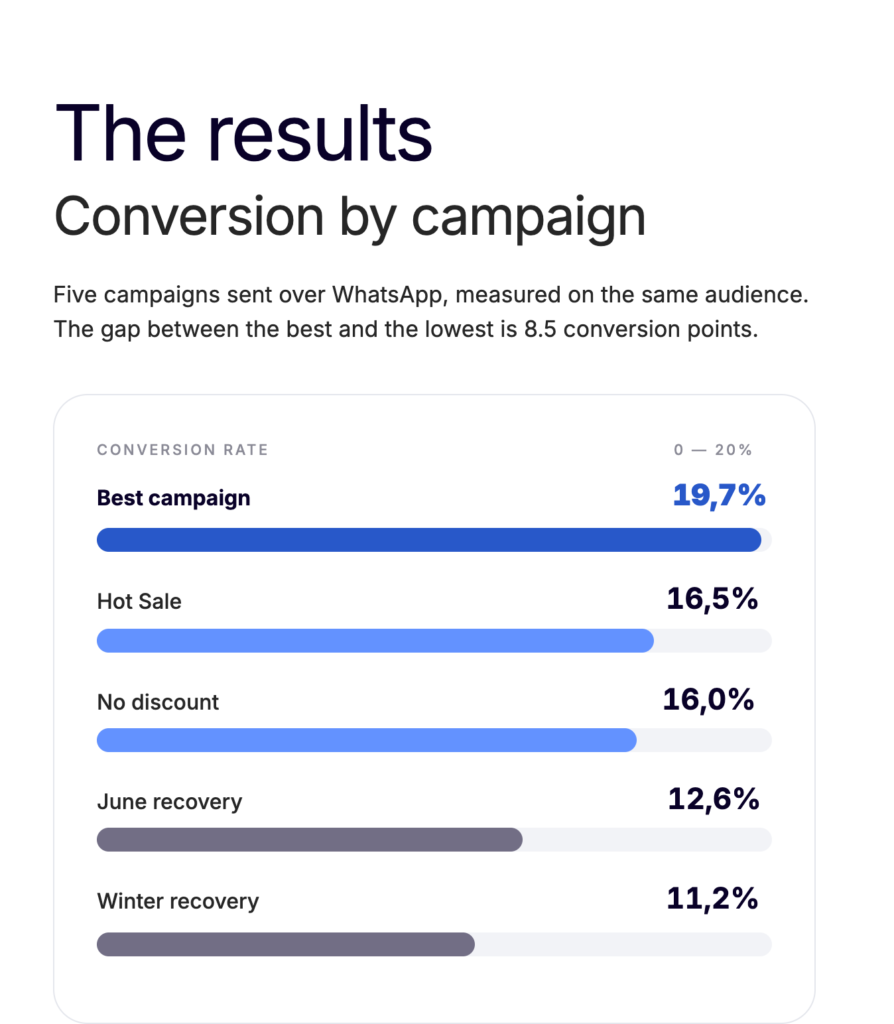
The most direct figure is revenue: $329.7 million Argentine pesos managed through the channel in a single semester, with 1,479 completed sales. But the campaign-by-campaign breakdown is what explains how that number was reached. The best-performing campaign hit 19.7% conversion, followed by the Hot Sale campaign at 16.5% and a no-discount purchase campaign at 16.0% — this last figure matters because it shows conversion didn’t depend solely on offering a lower price.
The abandoned cart module specifically showed 12.6% conversion in a June recovery campaign and 11.2% in a winter recovery campaign. These numbers confirm something many eCommerce teams write off as lost: a significant share of abandoned carts is recoverable when the reactivation process is automated and well designed, rather than left to chance for the customer to return on their own.
Why this result matters for the apparel market
According to the annual study by the Argentine Chamber of Electronic Commerce (CACE), eCommerce in Argentina generated 34 trillion pesos in revenue in 2025, 55% more than the previous year, and apparel ranks among the country’s ten best-selling online categories.
In that context, Maria Cher’s performance isn’t an isolated case: it shows that a vertical with high price and discount competition can sustain conversion through a well-automated conversational channel, rather than relying solely on markdown campaigns.
The same pattern of automation with measurable results repeats across other verticals in ChatCenter’s customer base, such as Movistar Mexico and Santander, where the hybrid AI-and-human-support model sustains conversion even at a much higher volume of conversations. The difference between a WhatsApp channel that only answers questions and one that actually sells lies in automating the full process, not in bolting a chatbot onto an existing manual flow.
Maria Cher’s case gives a concrete benchmark to compare against your own operation: how much revenue is being managed through WhatsApp today, what share of abandoned carts has any recovery process behind it, and how much of the support team’s time goes to inquiries that could be resolved automatically. Those three questions are the starting point before evaluating any provider.
Turn your WhatsApp channel into a sales engine with end-to-end automation, just like Maria Cher did. Book a call with ChatCenter and assess the potential of your own operation.