
Many companies still manage collections using manual processes, phone calls, and email follow-ups. Today, artificial intelligence makes it possible to automate much of that process through WhatsApp conversations, reducing operational costs and accelerating payment recovery.
Finance and customer experience teams are discovering that collections processes can evolve from a reactive, manual model to an intelligent, automated, and conversational system. In this context, AI in collections is emerging as a strategic tool for companies seeking to scale operations without damaging their relationship with customers.
What AI in collections is
AI in collections consists of applying artificial intelligence, automation, and data analysis to manage payment recovery processes more efficiently. Through conversational agents and automated workflows, companies can send reminders, negotiate payments, and recover debts in a scalable and personalized way.
This approach replaces traditional manual processes with systems capable of managing thousands of conversations simultaneously. Artificial intelligence analyzes customer behavior, determines the best time to contact them, and adapts the message to increase the probability of payment.
Technological evolution has also enabled the integration of conversational channels such as WhatsApp, which has become one of the most effective ways to interact with customers. According to Statista, WhatsApp reached three billion monthly active users in March 2025, making it one of the most widely used messaging platforms in the world. For companies, this reach turns WhatsApp into a strategic channel for managing real-time customer interactions, including support, sales, and automated collections processes (Statista, 2025).

Worldwide monthly active WhatsApp users (in millions) from April 2013 to March 2025 – WhatsApp; Facebook; Statista 2025.
By automating these processes, organizations can reduce friction in communication, accelerate payment recovery, and improve the customer experience even in sensitive situations such as an outstanding debt.
Impact of automation in collections and operational efficiency
One of the biggest benefits of automation applied to collections is improved operational efficiency. Companies can manage a much larger volume of interactions without proportionally increasing operational costs.
A McKinsey study indicates that AI-based automation can reduce operational costs in financial and administrative processes by between 20% and 30%, particularly in repetitive tasks such as payment follow-ups or sending reminders.
In collections processes, automation makes it possible to:
- Reduce time spent on manual customer contact.
- Automate payment reminders at strategic moments.
- Prioritize accounts based on recovery probability.
- Integrate CRM, billing, and customer behavior data.
In addition, conversational systems can resolve a large portion of queries related to billing, due dates, or payment methods without human intervention. This frees teams to focus on complex cases or higher-value negotiations.
Companies specializing in conversational automation such as Chat Center have developed solutions capable of managing interactions from the first contact to the final resolution of the process. This End-to-End approach, based on artificial intelligence, allows organizations to scale conversation management without sacrificing quality or response speed.
In fact, experience accumulated from more than 10 million managed chats shows that well-designed automation can simultaneously improve operational efficiency and customer experience.
AI First in the conversational collections experience
The concept of an AI First company implies designing processes from the start with artificial intelligence as a central part of the operation. In collections, this means building an automated conversational experience that supports the entire customer contact cycle.
AI agents can initiate reminder conversations before the due date, manage pending payments, or answer billing questions in real time. All of this happens within channels familiar to the user, such as WhatsApp.
The advantages of this approach include greater availability, communication consistency, and the ability to personalize interactions at scale.
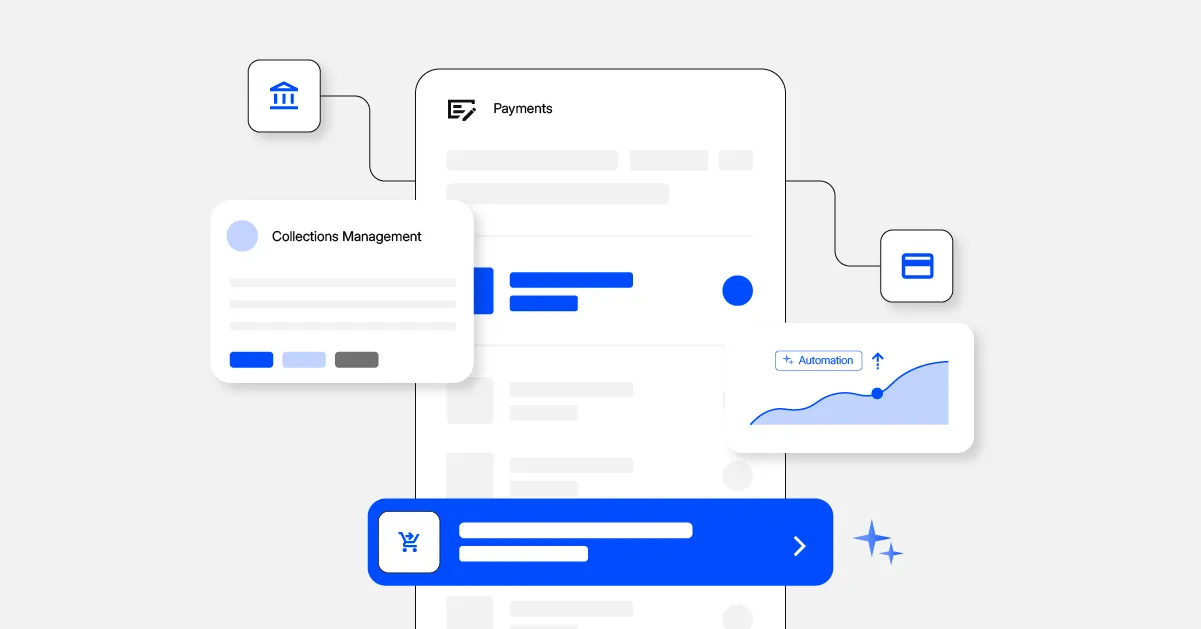
Modern conversational platforms also allow collections processes to integrate with eCommerce systems, CRM platforms, and payment solutions. This makes it possible for customers to resolve their debt within the same conversation, without needing to switch channels.
The result is a simpler and more direct experience for the customer. The conversation can start with an automatic reminder and end with payment confirmation within the same flow.
In commercial environments, conversational models have demonstrated relevant conversion rates. In sales and customer support automation solutions implemented by Chat Center, AI agents achieve an average conversion rate of 18%, demonstrating the potential of conversational interaction in commercial and financial processes.
What market data says about automation and collections
More and more companies are automating financial processes with artificial intelligence in order to scale operations without increasing team size. According to Gartner, an increasing number of financial organizations plan to increase investment in AI-driven automation to improve efficiency and customer experience by 2026.
Customer contact processes represent a significant portion of operational costs in financial departments. Automating these interactions makes it possible to improve results without expanding teams.
In conversational messaging, WhatsApp has consolidated its position as one of the most effective channels for business communication. Statista data shows that message open rates in messaging apps significantly exceed those of email marketing, making them an especially efficient channel for critical communications such as payment reminders.
Business cases also reflect this impact. Companies such as Movistar and Assist Card have implemented AI-based conversational strategies to improve commercial and customer service processes, achieving improvements in conversion, operational efficiency, and user experience.
In some cases, these strategies have even doubled commercial management capacity or increased revenue through conversational digital channels.
This demonstrates that automation not only optimizes existing processes but can transform the way companies interact with their customers.
How to start applying AI in collections
Implementing artificial intelligence in collections does not require transforming the entire operation overnight. Companies usually start with specific processes that have a high volume of interactions and a relatively structured flow.
One of the most common entry points is automating payment reminders and follow-ups for overdue invoices through conversational messaging. From there, it is possible to integrate new layers of automation that include payment negotiation, payment link generation, or customer data updates.
The process typically begins with a discovery phase to identify automation opportunities within the current collections workflow. Conversational flows are then designed, data systems are integrated, and AI agents are trained.
Companies specialized in conversational automation such as Chat Center support this process with a gradual implementation model that includes flow design, technology integration, and continuous optimization based on results.
This approach allows organizations to evolve from a manual contact system to a data-driven conversational automation strategy without interrupting existing operations.
Transforming collections into a conversational experience
Automation powered by artificial intelligence is redefining the way companies manage financial processes. Instead of relying exclusively on phone calls or emails, organizations can interact with customers through conversational channels that offer greater speed, personalization, and efficiency.
When these systems are properly integrated with CRM platforms, payment solutions, and analytics tools, collections management stops being a reactive process and becomes a proactive, results-oriented strategy.
Discover how to turn WhatsApp into your main sales channel with AI-powered End-to-End automation.