

En un negocio donde el cliente necesita respuestas inmediatas, muchas veces en situaciones críticas, los tIn a business where customers need immediate answers—often in critical situations—response times are not a detail: they are the experience. Travel insurance chatbots transform this friction point into a powerful advantage by combining automation, 24/7 availability, and conversion capabilities.
What are travel insurance chatbots?
Travel insurance chatbots are automated systems that use artificial intelligence to manage customer conversations across digital channels—mainly WhatsApp—handling inquiries, generating coverage quotes, and supporting purchase or assistance processes in real time.
Their value is not just about responding quickly, but about doing so with context, continuity, and the ability to take action within the commercial or service flow.
Impact on sales and automation: from support to conversion channel
For years, insurance customer service channels operated as cost centers. Today, when properly designed, they become revenue engines.
Conversational automation reduces first response times—critical in the travel insurance industry—while also increasing conversion rates. Implementation data shows that users who receive immediate attention are significantly more likely to move forward with a purchase.
At this point, WhatsApp plays a key role. With more than 3 billion monthly active users (Statista, 2025), it is not only the most widely used channel but also the most natural one for interaction. The real differentiation appears when the conversation goes beyond answering and starts guiding the user:
- Detects purchase intent
- Collects relevant travel data
- Generates automatic quotes
- Handles objections in real time
- Facilitates payment
This is what turns chat into an active funnel.
Additionally, real conversational automation implementations show average conversion rates close to 18% in AI-managed sales, along with recovery strategies reaching up to 25% for incomplete processes.
This reflects a flow design where data and speed are part of the structure.
AI First in conversational experience: the structural shift
Adopting chatbots is not about adding another channel—it is about redesigning how the company interacts with the customer.
The AI First approach means artificial intelligence is not added at the end of the process, but instead structures the operation from the beginning.
In travel insurance, this translates into:
- Immediate service without time constraints
- Ability to scale demand peaks (e.g., high seasons)
- Unification of pre-sales, sales, and post-sales in a single channel
- Reduction of operational errors in quoting and issuance
According to McKinsey, companies implementing intelligent automation in customer service can reduce operational costs by 20% to 40%, while improving customer satisfaction.
But there is something even more interesting: the perception of control. The customer no longer feels they are “waiting for a response”—they feel they are moving forward. And in insurance, that difference is everything.
Real cases and market metrics
The impact of chatbots in insurance and related services is no longer theoretical—it is already happening. Companies in the sector have managed to:
- Reduce first response times to under one minute
- Increase revenue through conversational channels
- Scale operations across multiple countries without proportionally increasing teams
A relevant case is Assist Card, which achieved a 53% increase in revenue by implementing a hybrid conversational model (AI + humans), along with a significant improvement in satisfaction rates.
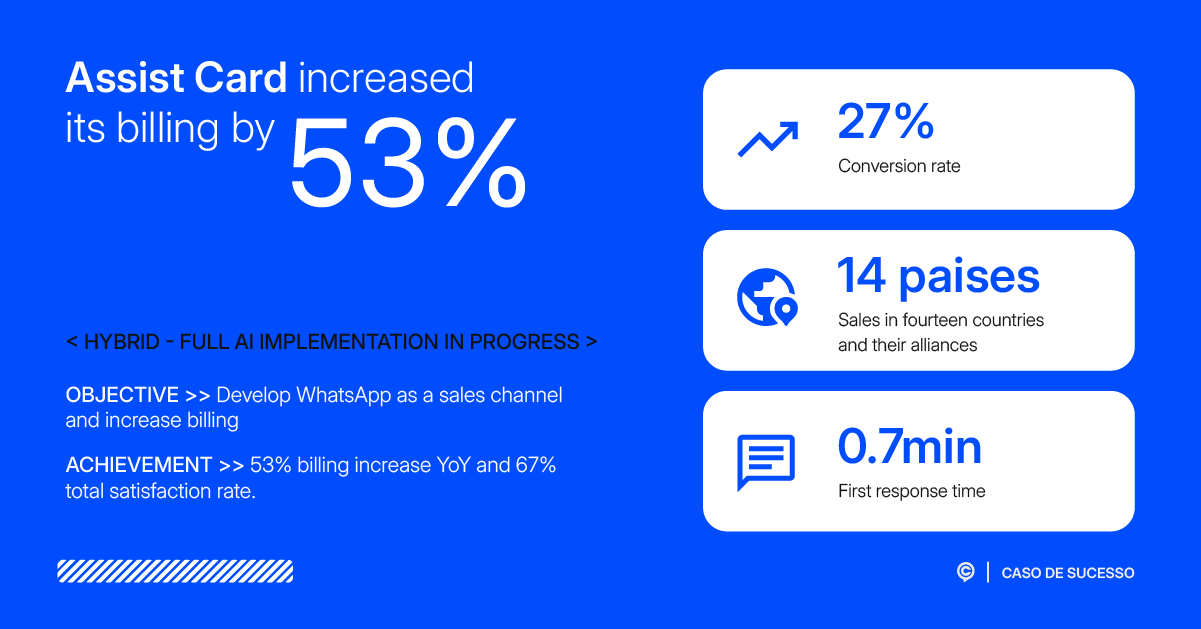
Infographic of results from the Assist Card success case, highlighting the 53% increase in revenue and the reduction of response time to 0.7 minutes through the use of AI and WhatsApp.
Another representative case in travel insurance is Pax Assistance, which, together with Chat Center Service, developed a conversational sales and support model via WhatsApp. This allowed them to scale operations without losing a human-centered approach: the partnership centralized the channel, reduced response times to under 5 minutes, and transformed the contact point into a true commercial engine. They achieved a 21.47% conversion rate on chats, representing 13% of total business revenue, with 60% year-over-year growth and peaks where revenue tripled—demonstrating that automation, conversational design, and experience focus directly impact both revenue and brand perception.
Meanwhile, Gartner projects that by 2026, more than 75% of customer service interactions will be mediated by AI. The conclusion is simple: conversational channels are no longer experimental—they are infrastructure.
Impact of chatbots on key insurance business KPIs
Beyond operational improvements, conversational automation directly impacts critical business indicators. This is not efficiency for efficiency’s sake—it is about profitability, conversion, and scalability.
Below is the impact of chatbots on key travel insurance KPIs:
| Strategic KPI | Traditional model | Conversational AI model |
|---|---|---|
| Cost per interaction | High (structure + human resources) | Reduced (automation + scalability) |
| Conversion rate | Low / not optimized | Up to 18% in conversational flows |
| Lead recovery / drop-offs | Limited or manual | Up to 25% automated |
| Time to close | Slow (multiple interactions) | Accelerated (guided flow) |
| Service capacity | Limited by staff | Scalable without friction |
| NPS / satisfaction | Variable | Sustained improvement (instant experience) |
| Channel ROI | Hard to measure | Measurable in real time |
| Demand generation | Dependent on external channels | Integrated (Click to WhatsApp + campaigns) |
This is no longer about “optimizing service”—it is about changing the economic equation of the channel.
How to start becoming AI First in travel insurance
The most common mistake is trying to implement a chatbot as an isolated solution. That usually results in bots that respond but do not solve.
Instead, the correct approach is to design the entire process, starting with understanding the customer journey—from the moment they seek information to when they need assistance during the trip.
Then identify where automation can generate real impact:
- Quoting and comparing coverage
- Managing frequent inquiries
- Lead follow-up
- In-trip assistance
- Post-sale and retention
Finally, integrate technology, data, and operations. This is where end-to-end automation models make the difference: they connect eCommerce, CRM, and messaging channels into a continuous flow.
Chat Center Service, as a Meta Business Partner, works precisely under this approach: transforming WhatsApp into a complete sales and service channel with full integration and a focus on results.
The real shift: speed, context, and decision
Reducing response times matters—but it is not enough. The real value of chatbots in travel insurance lies in combining three factors:
- Speed: immediate response
- Context: understanding what the customer needs
- Action: solving or advancing the process
When these three elements work together, both experience and business improve. Because customers do not measure service quality based on what companies do internally—they measure it by how easy it is to solve their problem.
Travel insurance chatbots are not a trend. They are a concrete response to a structural problem: the gap between customer expectations and companies’ response capabilities.
The companies that close that gap will not only provide better service—they will also sell more, with less friction and greater efficiency. And in a competitive market, that is not an incremental improvement. It is a clear advantage.
Discover how to turn WhatsApp into your main sales channel with AI-driven end-to-end automation