

For the past fifteen years, eCommerce learned to optimize the click: CTR, CPC, landing page conversion rate, cost per acquisition. The entire digital value chain was built around driving traffic to a URL and waiting for the user to complete a form or reach checkout.
That model worked reasonably well while the digital channel was the only digital channel. Today, there’s a structural shift underway that has nothing to do with adding one more channel.
When a company implements conversational AI automation — an agent that responds, qualifies, advises, and closes within a WhatsApp conversation — the economic unit of the digital business stops being the click and becomes the token: each interaction has a cost (AI inference) but also a direct, traceable value (conversion, recovery, retention). That changes how the business is measured, managed, and scaled.
In this article, we’ll reveal what operational decisions that shift implies for those managing budgets in eCommerce, sales, or CX.
The Old Model: You Optimize Clicks, You Lose Conversations
The classic funnel follows a linear logic: impression → click → page → form → conversion.
According to data from the Baymard Institute (2024), fewer than 3% of eCommerce site visitors end up buying in that session, which means the vast majority abandon the process somewhere along the way. Some return if retargeting works well; most simply don’t come back.
The problem isn’t just the conversion rate — it’s that this model treats all users the same until they demonstrate intent. The form doesn’t distinguish someone ready to buy from someone comparing prices. The cart recovery email arrives hours later, when the context has already changed. And the sales team receives cold leads that require warming up before any progress can be made.
The cost of that model isn’t just the lost conversion. It’s the opportunity cost of every conversation that never happened.
The New Economic Unit: the Token, the Conversation, the Revenue per Chat
When a generative AI conversational agent is deployed over WhatsApp, the logic changes. Each interaction has three measurable components: inference cost (AI tokens consumed), value generated (sale closed, cart recovered, query resolved without human intervention), and response speed (seconds, not hours).
ChatCenter operates with this logic across more than 200 companies and 10 million managed chats. Internal data shows conversion rates of 18% on conversations initiated from Click-to-WhatsApp campaigns, and abandoned cart recovery of 25% via automated sequences. Those numbers are the result of treating the conversation as the unit of sale, not as a step before the sale.
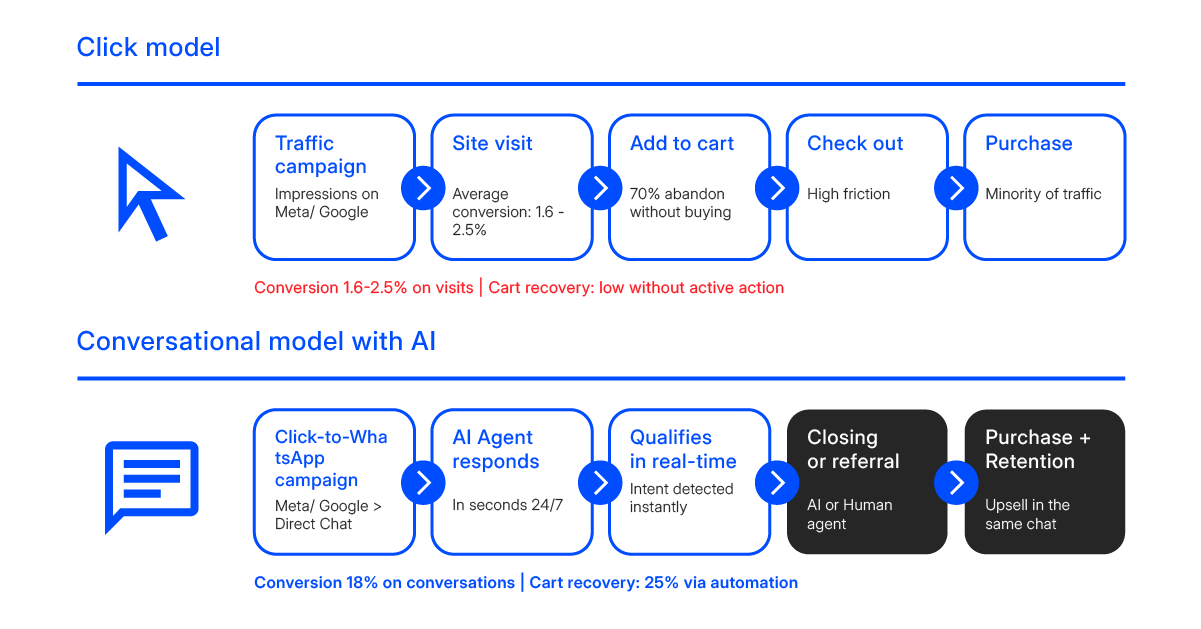
Chart 1. The click funnel filters silently: out of every 100 visitors, fewer than 3 buy. The conversational model inverts the logic: the conversation is the sale, not just the step before it. Sources: Smart Insights / Statista (2024–2025), Baymard Institute (2024), ChatCenter internal data.
| Dimension | Click Model | Conversational Model |
|---|---|---|
| Economic unit | Click / visit | Conversation / token |
| Main KPI | CTR, CPC, landing conversion rate | Revenue per chat, cost per conversational sale |
| Response speed | Hours (email, retargeting) | Seconds (AI agent 24/7) |
| Lead qualification | Post-form, cold | Real-time, within the conversation |
| Typical conversion rate | 1–3% of visits (Baymard, 2024) | 18% of initiated conversations (ChatCenter) |
| Cart recovery | Late email, low open rate | 25% recovery via automated sequence (ChatCenter) |
| Operational scale | Requires more team for more volume | AI handles 80–85% of volume without linear variable cost |
The metric shift reflects a different business architecture.
What Changes in the Funnel When AI Starts Executing
In the conversational model, the funnel is not a fixed sequence. The AI agent qualifies intent in real time, adapts the offer based on user responses, and can close a sale, hand off to a human, or reactivate the conversation later depending on context. There’s no single path between the first message and conversion.
This has an operational consequence: the sales team no longer receives leads — it receives qualified opportunities. AI handles the volume; humans focus on the cases that require judgment.
Marketing’s Role Shifts Toward the Qualified Conversation
With Click-to-WhatsApp, a campaign on Meta or Google doesn’t drive traffic to a landing page: it opens a conversation directly with the agent. The campaign KPI stops being CTR and becomes cost per qualified conversation and revenue generated by that channel. That also changes how creatives are designed, how audiences are segmented, and how ROI is measured.
To go deeper on this topic, we recommend reading ROI in enterprise AI projects: why 95% generate no return
Post-sale and Retention Enter the Same Flow
WhatsApp Marketing Automation allows you to trigger post-purchase sequences, repurchase reminders, and upsell campaigns within the same channel where the sale occurred — without asking the customer to return to the site or open another medium. The conversation simply continues, reducing retention costs and increasing LTV without adding friction to the already established relationship.
The Hybrid Model: When AI Acts Alone and When a Human Steps In
One of the most common objections is: “if AI handles the conversations, I lose control over what’s being said to my customers.” It’s a legitimate concern, but it starts from a wrong premise: that the conversational model is all or nothing.
In practice, the model that works is hybrid. The AI agent handles 80–85% of conversations autonomously: it answers frequent queries, presents products, generates the cart, and processes payment. When it detects a situation requiring judgment — a complex complaint, a price negotiation, a high-value customer — it hands the conversation off to a human agent with all context loaded.
This isn’t a limitation of the model: it’s an intentional design. AI scales the volume; the human team adds value where it truly matters. The operational result is a smaller sales team serving more customers with a higher close rate.
When This Model Doesn’t Work (or Isn’t Ready Yet)
Not every sales process is a candidate for conversational automation right now. The model performs well when there’s volume — at least several hundred conversations per month — when the product or service has a reasonably standardizable sales logic, and when there’s a team with the capacity to iterate on conversational flows.
It doesn’t perform well in highly complex consultative sales where every proposal is unique, in sectors with strict communication regulations (some segments of health or finance), or in companies that don’t have clarity about their current sales process. AI automates what already works; it doesn’t fix a broken sales process.
Implementation also requires real integration with the existing stack: eCommerce, CRM, payment gateway. An agent disconnected from inventory or order status creates more friction than it resolves.
A Reference Case: How Assist Card Scales Service Without Scaling Headcount
Assist Card, the travel assistance company operating in more than 100 countries, implemented conversational automation with ChatCenter to manage coverage inquiries, assistance activation, and case follow-up. The operational result was a significant reduction in first response time and an increase in first-contact resolution — without a proportional increase in the support team.
The relevant data point isn’t just efficiency. It’s that a customer who needs assistance abroad and receives a response in seconds has a radically different experience from one waiting in a call center queue. That difference has a direct impact on retention and referrals.
What You Should Do Differently Starting Tomorrow
If you manage budget in eCommerce, sales, or CX and are evaluating whether to implement conversational AI automation, three operational questions are worth more than any demo:
First: how many sales or support conversations do you process per month that don’t end in a close today — due to slow response or lack of team capacity? That number is the ceiling of your opportunity.
Second: do you have revenue traceability by conversational channel, or do you only measure volume? If you don’t know how much your WhatsApp channel sells, you don’t know how much you’re leaving on the table.
Third: is your current sales process predictable enough for an AI agent to execute it consistently? If the answer is yes for 60% of cases, you already have the foundation to start.
The shift from clicks to tokens isn’t a trend — it’s a business architecture decision that companies are making today. Those who do it well aren’t adding a bot: they’re redesigning how sales are executed at scale.Want to evaluate whether this model applies to your operation? Schedule a call with the ChatCenter team and we’ll review your conversational channel’s conversion potential together: