
More and more B2B companies are leaving traditional forms behind. The reason isn’t aesthetic or technological—it’s economic. When conversation replaces the form, conversion stops depending on user patience and starts depending on the quality of the experience.
What Click to WhatsApp is and why it’s replacing forms
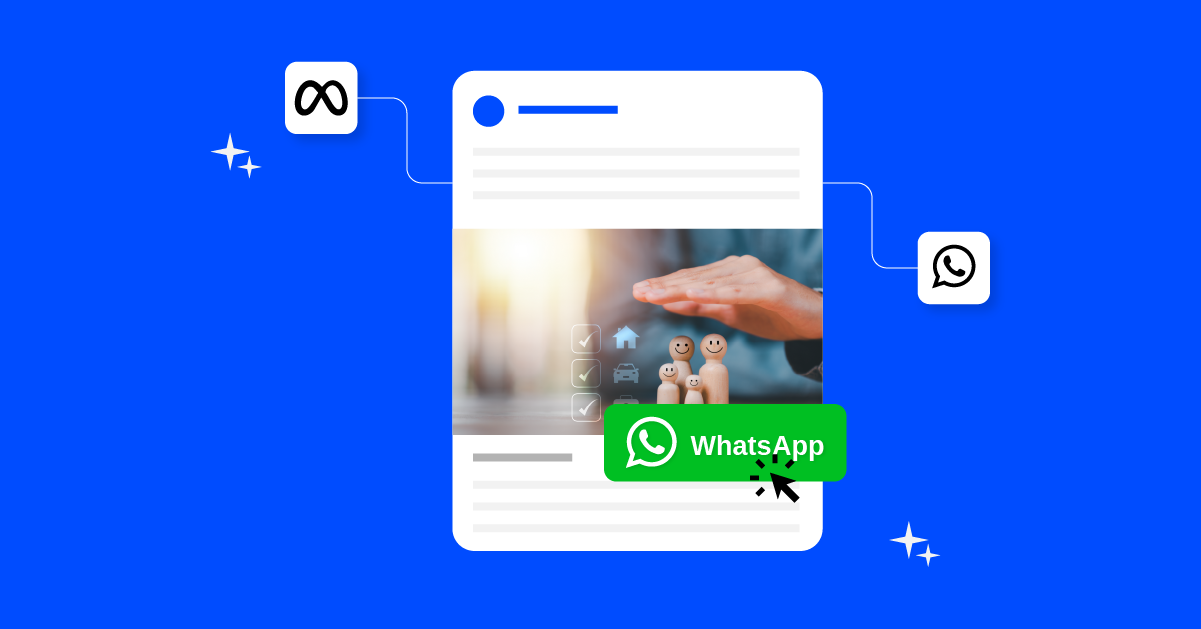
Click to WhatsApp is a feature that allows users to start a direct conversation with a company from ads, websites, or digital campaigns, taking them to WhatsApp in a single click.
Unlike forms, where users leave their data and wait, this model removes friction and activates immediate interaction. The logic shifts: instead of capturing a lead, you start a conversation.
This shift has deep implications. Forms were designed to collect information; Click to WhatsApp is designed to resolve intent in real time. In contexts where response speed directly impacts purchase decisions, this difference is critical.
According to Meta data, Click to WhatsApp ads generate significantly higher interaction rates than traditional formats, especially in mobile-first markets like Latin America.
Impact on sales and automation: from leads to conversations that convert
The problem with forms isn’t technical—it’s structural. They generate leads, but they don’t guarantee effective contact.
Click to WhatsApp, on the other hand, connects directly with users who already have intent. That changes the starting point of the funnel.
When this channel is combined with automation and artificial intelligence, the impact on sales becomes tangible:
- Response time is reduced to seconds
- Effective contact rate increases
- Sales cycles accelerate
In real Chat Center implementations, AI agents achieve an average conversion rate of 18%, turning conversations into actual sales.
Additionally, in demand recovery strategies such as abandoned carts, conversion can reach 25%, proving that conversation doesn’t just capture leads—it recovers lost revenue.
This redefines the role of the channel: it stops being an entry point and becomes a revenue engine.
Forms vs Click to WhatsApp: differences in performance and conversion
To understand why more and more companies are moving toward conversational models, comparing both approaches across key variables makes the impact on business, experience, and operational efficiency clear.
This comparison doesn’t imply that forms will disappear, but it clearly shows that in contexts where speed and personalization impact purchase decisions, conversation positions itself as the most efficient channel to convert demand into revenue.
AI First in conversational experience: when selling is conversing
Adopting Click to WhatsApp without an automation strategy is like opening a store without salespeople.
The real leap happens when it’s integrated into an AI First model, where artificial intelligence doesn’t just respond—it manages the entire sales process.
In this approach:
- The user starts a conversation from an ad
- An AI agent qualifies the lead
- Products or services are presented
- The cart is built
- Checkout is sent
- The sale is completed
All within the same conversation.
Chat Center operates under this end-to-end automation model, where the experience doesn’t break across channels or depend on disconnected tools. Integration with eCommerce ensures that conversation isn’t a complement—it’s the main transaction channel.
This approach isn’t theoretical. Companies like Movistar or Assist Card already use conversational models to scale sales, improve response times, and optimize customer experience.
What the data says: from user behavior to business decisions
The shift toward conversational channels isn’t a trend—it’s backed by real user behavior.
According to Statista, WhatsApp exceeds 3 billion monthly active users, making it the most widely used messaging channel globally.
Meanwhile, studies from McKinsey & Company indicate that companies implementing automation in customer journeys can increase revenue by 10% to 15%, while significantly improving operational efficiency.
But the most relevant data point isn’t user volume—it’s expectation:
Customers expect immediate, personalized responses in the channel they already use.
That’s where forms lose relevance. Not because they’re obsolete, but because they don’t meet that expectation.
How to start being AI First with Click to WhatsApp
The most common mistake is thinking that implementing Click to WhatsApp is just adding a button—it’s not. It requires redesigning the commercial flow around conversation.
An effective approach starts with understanding three dimensions:
First, demand generation. Campaigns must be designed to attract users with intent, not generic traffic. Click to WhatsApp works best when the message already filters interest.
Second, conversation management. This is where AI comes in—not as a basic auto-response, but as an agent capable of interpreting context, guiding decisions, and advancing the sales process.
Third, system integration. Without connection to CRM, eCommerce, or payment tools, the conversation remains isolated and loses value.
Chat Center structures this process end-to-end: from acquisition strategy to final conversion, with a results-driven model and more than 10 million managed chats.
Additionally, as a Meta Business Partner, it guarantees security, scalability, and compliance standards that are essential in corporate environments.
The real shift: from capturing data to generating revenue
For years, companies optimized forms: fewer fields, better UX, more conversions. Today, the shift isn’t about optimizing the form—it’s about eliminating it when it adds no value.
Click to WhatsApp doesn’t replace all processes, but it does redefine where conversion happens. Instead of capturing data to sell later, it allows selling while the user is interacting.
That shift may seem subtle, but it’s structural—and the companies that understand it first are the ones capturing demand before their competitors.
The breaking point in digital conversion
The rise of conversational channels isn’t driven by technology—it’s driven by business logic: reducing friction, accelerating decisions, and improving experience.
Click to WhatsApp is currently one of the most effective tools to achieve this. But its real potential appears when it’s integrated into an AI-powered automation model.
That’s when it stops being just another channel and becomes a sales system.
Discover how to turn WhatsApp into your main sales channel with AI-powered end-to-end automation 👉🏼 https://chatcenter.net/book-a-call/